










How often should tyres be rotated?
The best place to start is your vehicle owner’s manual, as manufacturers may recommend different service intervals.
As a general guide:
- Passenger vehicles: Every 8,000–10,000km
- SUVs and 4WDs: Every 8,000–10,000km
- Electric vehicles: Every 6,000–8,000km, as the additional weight and instant torque can accelerate tyre wear.
If you’re already having your vehicle serviced, it’s a good opportunity to have your tyres inspected and rotated at the same time.
Why tyre rotation makes a difference
No two tyres wear exactly the same.
On front-wheel drive vehicles, the front tyres typically wear faster because they’re responsible for steering, braking and delivering power to the road. Rear-wheel drive vehicles place more demand on the rear tyres, while all-wheel drive systems distribute forces differently again.
By moving the tyres to different positions at regular intervals, the wear becomes more even across the entire set. That means:
- Longer overall tyre life.
- More consistent handling and braking.
- Better traction throughout the life of the tyres.
- The ability to replace all four tyres together, helping maintain the vehicle’s original handling characteristics.
It’s worth remembering that tyre rotation won’t fix problems caused by incorrect tyre pressures, poor wheel alignment or worn suspension components. If your tyres are wearing unevenly, your Giti dealer can inspect the vehicle to identify the cause.
Replacing two tyres? Fit them to the rear.
Ideally, tyres should always be replaced as a complete set. This keeps tread depth consistent across the vehicle and delivers the most balanced handling.
If you only need to replace two tyres, they should generally be fitted to the rear axle, regardless of whether your vehicle is front-wheel drive or rear-wheel drive.
The reason is simple. New tyres have deeper tread, providing better grip in wet conditions. Having the tyres with the greatest grip on the rear helps improve stability and reduces the risk of oversteer or fishtailing during emergency manoeuvres.
If the difference in tread depth between the front and rear tyres becomes significant, typically more than 2–3mm, it may be worth replacing all four tyres.
Four-tyre and five-tyre rotation
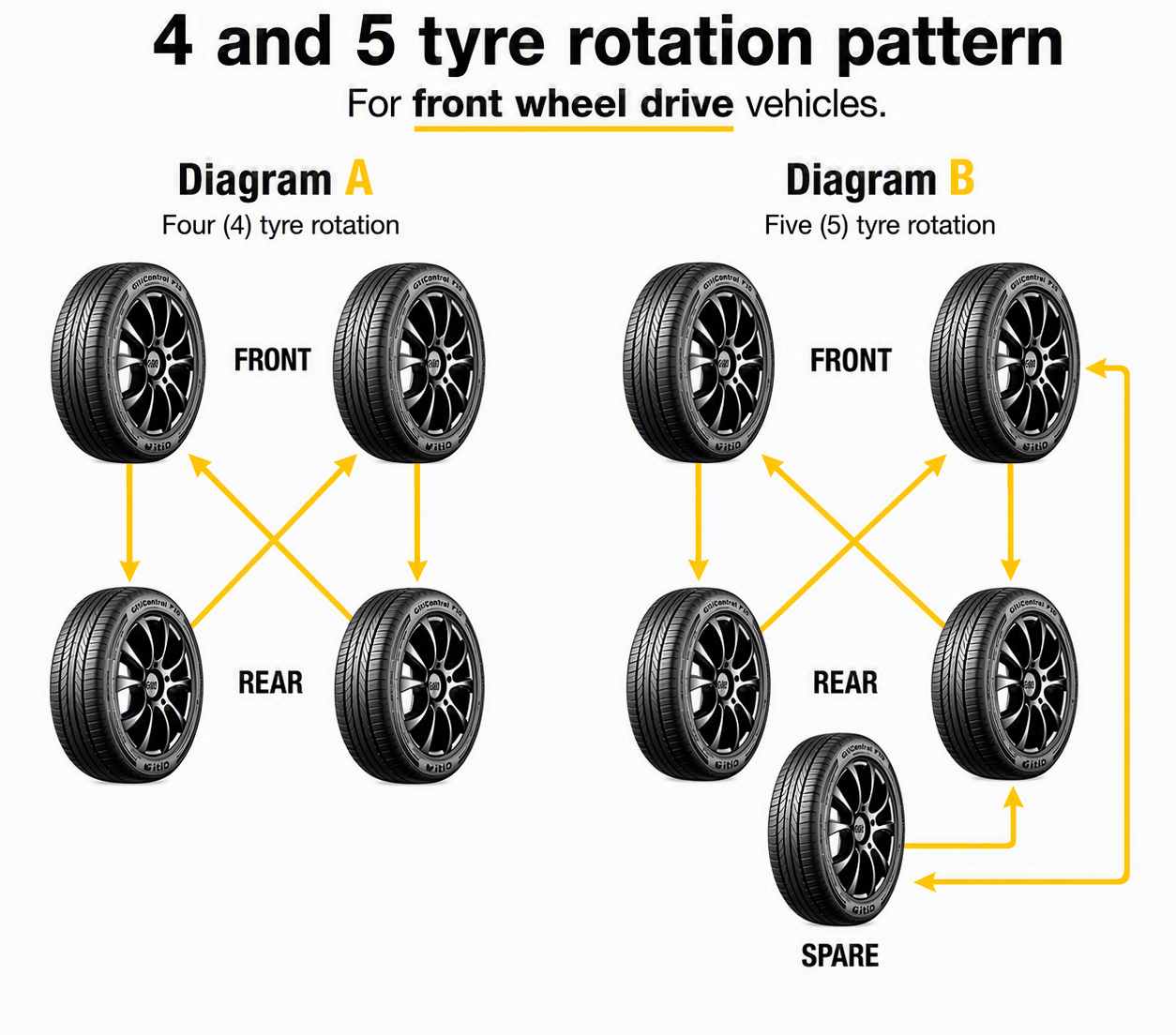
Most vehicles follow a four-tyre rotation pattern, with the tyres moved between the front and rear axles according to the drivetrain and tyre design.
Some 4WDs and SUVs with a full-size matching spare can benefit from a five-tyre rotation program.
Including the spare means all five tyres share the workload, helping them wear at a similar rate. It can also increase the overall distance you’ll get before replacing the complete set.
A five-tyre rotation should only be carried out if the spare tyre matches the other four tyres in size, construction, load index and speed rating. Temporary spare tyres should never be included.
Don’t forget balancing and wheel alignment
Rotating your tyres is only one part of keeping them in good condition.
Regular wheel balancing helps prevent vibration and uneven tread wear, while maintaining the correct wheel alignment ensures the tyres meet the road at the correct angle.
If you notice your steering wheel isn’t centred, the vehicle pulls to one side or your tyres are wearing unevenly, it’s worth having the alignment checked as soon as possible.
Get the most from your Giti tyres
Looking after your tyres doesn’t require much time, but it can make a noticeable difference to their lifespan and performance.
Checking tyre pressures regularly, rotating your tyres at the recommended intervals, and keeping your wheels balanced and aligned all work together to help you get the maximum kilometres from every set of Giti tyres.
